
How to Evaluate Acrylic Waterproof Coatings After Water Immersion
A coating should be judged while wet — and again after it dries.
A waterproof coating that looks fine after 24 hours in water can still fail on a roof, balcony or water-retaining structure. A reliable evaluation compares the film before immersion, immediately after removal and again after drying.
This guide covers appearance, water uptake, wet adhesion, mechanical-property retention and recovery — then connects each result to practical formulation adjustments.

Whitening, blisters, softening, tack and cracking.
Wet mass gain and net mass change after drying.
Adhesion to the actual substrate while wet.
Tensile strength and elongation versus control.
Whether the film regains its original condition.
The key is not simply whether a film looks different after immersion. It is whether water exposure causes temporary changes or permanent damage to the coating and its bond with the substrate.
01Why Water Immersion Testing Matters
Acrylic waterproof coatings are water-based films. Once cured they resist liquid water, but in service they may face rain on a young film, ponding on a flat roof, damp substrates and, in some applications, prolonged contact with water. Immersion testing helps show how a cured film behaves when it is wet.
ASTM D870 describes water immersion as a practice for coating research, specification acceptance and quality control. A pass/fail result is commonly used, but the practice also cautions that laboratory immersion should not be treated as equivalent to natural exposure unless the two have been correlated.
Match the test to the real exposure. According to the standard listing, China’s polymer emulsion architectural waterproof coating standard, JC/T 864, covers uses where water immersion is not prolonged. Its 2023 edition added a water-resistance test and an optional water-absorption test. A coating intended for intermittent wetting should not be approved for continuous immersion based only on a short soak.
For ponding water, an IIBEC technical paper emphasizes wet adhesion. Swelling puts stress on the bond between coating and substrate, increasing the risk of delamination.
02What Happens to the Film in Water
Water can affect an acrylic film in several ways. Each leaves a different sign and should be recorded separately.
- Uptake and swelling. Water enters through hydrophilic groups, water-soluble additives and voids. The film swells, stressing the bond to the substrate.
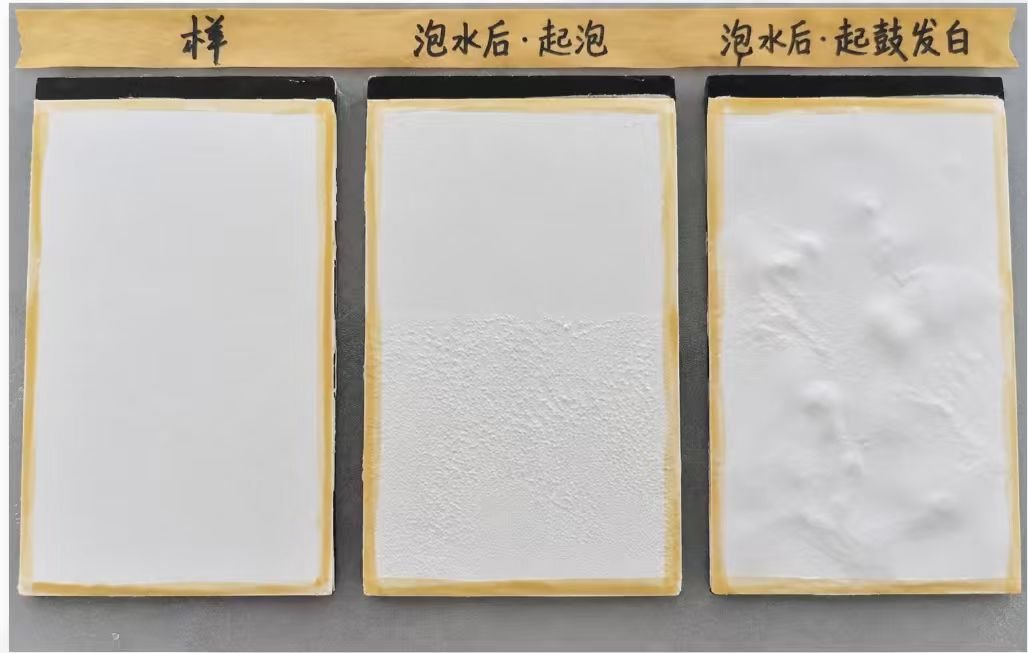
- Whitening. Free surfactant that migrates during drying can form water-swollen pockets in the film. These scatter light and make the film look milky. The effect may reverse after drying. A 2025 industry article links whitening to surfactant remaining in the water phase and weak colloidal stability during drying.
- Blistering. High surfactant levels, trapped water or vapor from a damp substrate can contribute to blisters. Blisters that remain after drying indicate a more serious defect than temporary whitening.
- Leaching. Dispersants, surfactants, thickeners and salts may wash out. The IIBEC paper notes that water-soluble components can leach from acrylic roof coatings, making mass loss after redrying useful to measure.
03Test Methods and Standards
No single standard covers the full evaluation. Combine an immersion practice with the property tests required by the product standard or customer specification.
| Standard | What it covers | How to use it |
|---|---|---|
| ASTM D870 | Immersion of coated specimens, fully or partly, in distilled or demineralized water at ambient or raised temperature. | Controls the immersion procedure. Specimen preparation, conditions and acceptance criteria come from the relevant specification. |
| EN ISO 2812-2:2018 | Water immersion method for single- or multi-coat paint and varnish systems, partly or fully submerged. | Evaluates the effect of water on the coating and, where required, the substrate beneath. |
| ASTM D6083 | Specification for liquid-applied acrylic roof coatings, including tensile strength, elongation, adhesion, water swelling, permeance, tear resistance and low-temperature flexibility. | Provides a property set for evaluating acrylic roof coatings. Check the applicable edition for current limits. |
| JC/T 864 | China’s standard for polymer emulsion architectural waterproof coatings. The 2023 edition added a water-resistance test and optional water-absorption test. | Use the edition in force for test conditions and acceptance limits. |
| GB/T 16777-2008 | Test methods for building waterproof coatings, including film preparation, tensile properties, bond strength and wet-substrate bond testing. | Reference for film casting and wet-substrate adhesion method details. |
For product development, labs may add a free-film screen. The 2025 article cited above used films cast on glass with a 6 mil drawdown bar, dried for 24 hours at 22 °C and 50% relative humidity, immersed for 24 hours and rated visually, with uptake tracked over seven days. This is a paint-film screen. Waterproof coatings are thicker and need longer curing, so adapt the method to the actual product.
04Step-by-Step Evaluation Procedure
This is a practical protocol. Adjust the times, temperature and substrates to match the product specification and service conditions.
- Define the exposure. Decide whether the product faces intermittent wetting (roofs, walls and balconies) or continuous immersion (tanks and pools). This determines immersion time and temperature.
- Prepare specimens. Make free films for uptake and tensile testing, plus coated panels on the actual substrate for adhesion. Apply at the intended dry-film thickness, cure fully as directed by the TDS or standard, and record thickness. Keep unsoaked controls from the same batch. Seal panel edges to prevent water wicking in from the sides.
- Record the baseline. Weigh the films, photograph all specimens and note color and gloss.
- Immerse. Use distilled or demineralized water, as in ASTM D870, at a fixed temperature. Keep specimens apart and fully submerged, and keep the water clean.
- Inspect at set times. Example intervals are 1 hour, 24 hours, 3 days and 7 days. These are examples, not requirements. Record whitening, blisters, softness and tack.
- Test while wet. Remove specimens, blot surface water and test immediately. Measure uptake, rate appearance, test panel adhesion and pull tensile specimens. Use the same handling time for all samples.
- Dry back and retest. Dry under controlled conditions, reweigh, rate appearance again and repeat adhesion and tensile tests.
- Compare with the control. Report changes or percentage retention against the unsoaked control, using at least three replicates.
05Key Indicators and How to Judge Them
Compare every result with the unsoaked control. Two weighing formulas help separate absorbed water from material lost during immersion. Here, m0 is the dry mass before immersion.
U = (mwet − m0) / m0 × 100%
Net mass change after drying
Δm = (mredried − m0) / m0 × 100%
A negative net mass change means material leached out during immersion. For any mechanical property, retention is the soaked value divided by the unsoaked control value, multiplied by 100%.
| Indicator | How to measure | What to look for |
|---|---|---|
| Appearance | Photograph and visually rate at removal and after drying. | Whitening that fades on drying is less severe than blisters, softening or cracking that remain. |
| Water uptake, U | Track free-film weight gain over time. | A curve that keeps rising instead of leveling off suggests the film has not reached stable uptake. |
| Net mass change, Δm | Reweigh after drying back. | Negative values indicate leaching of surfactant, thickener or salts. |
| Wet adhesion | Peel or pull-off on the real substrate while wet, then after drying. | Record whether failure occurs at the substrate, within the coating or in the primer. |
| Tensile and elongation retention | Compare soaked and control films. | Large wet strength loss suggests softening. Elongation loss after drying may indicate embrittlement. |
| Recovery | Repeat tests after dry-back. | Properties should recover. Lasting defects indicate permanent damage. |
For orientation, the 2001 IIBEC paper reports that the roof-coating specification at that time asked for wet adhesion of at least 2.0 pli after one week underwater, compared with 4.0 pli dry. Limits change between editions, so check the current ASTM D6083 before using any figure.
06Formulation Factors That Decide the Result
Immersion performance depends largely on what remains in the dry film. Factors 1–3 below are discussed in published work; factors 4–8 reflect common formulation practice and should be confirmed in your own trials.
| # | Factor | Effect after immersion | Direction to test |
|---|---|---|---|
| 1 | Polymer Tg and film softness | Very soft films may allow water in easily, while waterproofing also requires elongation. | Choose Tg to balance water resistance and flexibility. In one 2025 study, a model acrylic film at about −20 °C was too soft to resist water; reactive-surfactant benefits appeared between about −5 and 10 °C. |
| 2 | Surfactant type and level | Free surfactant can migrate during drying and cause whitening; high levels can contribute to blistering. | Use only enough for stability. Polymerizable surfactants remain attached to particles and improved whitening in the cited study. |
| 3 | Acid monomer and pH | Neutralizing the latex can improve stability and particle packing. An unneutralized latex at pH 2 whitened more than one at pH 8–9 in the cited work. | Check the pH of the finished formulation. |
| 4 | Crosslinking | Can reduce swelling and softening in water. | Balance crosslinking against elongation; test elongation after immersion. |
| 5 | Filler type and loading | Porous or hydrophilic fillers may raise uptake; heavy loading can limit flexibility. | Compare fillers at equal dry-film thickness. |
| 6 | Dispersants, wetting agents and thickeners | Water-soluble additives can remain in the film and leach out. | Use effective grades at the lowest working dosage. |
| 7 | Defoamer | An incompatible defoamer may leave craters that become weak points in the film. | Choose for compatibility and inspect film continuity after immersion. |
| 8 | Cure and film thickness | An incompletely coalesced or under-cured film may show more whitening and uptake. | Apply coats within specification and allow full cure before testing. |
07Troubleshooting Guide
| Symptom after immersion | Likely causes | What to adjust or check |
|---|---|---|
| Milky whitening that fades on drying | Free surfactant, hydrophilic additives, incomplete coalescence or an unneutralized system. | Lower or replace surfactants, check pH and extend cure time. |
| Blisters that remain after drying | Moisture or vapor in the substrate, excess water-soluble material, weak adhesion or thick single coats. | Check substrate moisture, use a suitable primer or wetting agent, and apply thinner coats. |
| Soft, tacky film while wet | Low Tg, too much hydrophilic additive or low crosslink density. | Raise Tg slightly or add crosslinking; reduce water-soluble additives. |
| Uptake keeps rising | Hydrophilic polymer or additives, porous fillers, voids or craters. | Review emulsion and filler choice; check defoamer compatibility and film continuity. |
| Negative net mass change after drying | Leaching of surfactant, thickener, dispersant or salts. | Reduce dosage, change additive grades or lower free surfactant. |
| Wet adhesion drops sharply | Swelling stress, poor substrate wetting or an unprimed/damp substrate. | Reduce swelling, improve wetting, prime and control substrate moisture. |
| Elongation falls after drying | Leached flexibilizing components, over-crosslinking or embrittlement. | Review crosslinker level, coalescent and additive choices. |
08How JCT Chemical Can Help
JCT Chemical supplies acrylic emulsions for waterproof coatings together with defoamers, wetting agents, dispersants, thickeners and other additives. We support formulators with material selection and application advice.
If an immersion test shows whitening, blisters, high uptake or lost adhesion, share the formulation, substrate and exposure conditions. Our team can help review the likely causes and suggest the next test variables.
Evaluation Summary
- Appearance before immersion, immediately after removal and after drying.
- Water uptake and net mass change after redrying.
- Wet and dry adhesion on the intended substrate.
- Tensile strength and elongation retention against an unsoaked control.
- Exposure time, water temperature, dry-film thickness and replicate results.
09Frequently Asked Questions
How long should I immerse an acrylic waterproof coating?
There is no single answer. ASTM D870 describes how to run immersion but leaves duration to the specification. Published work uses 24 hours for a whitening screen and up to 7 days for uptake and wet adhesion. Continuous-immersion service needs a longer period set by the end-use requirement.
Why does my coating turn white in water and clear up when dry?
Water can collect in hydrophilic pockets, often around free surfactant, and scatter light. The effect may be reversible. Reduce free surfactant, check pH and make sure the film has coalesced fully.
Is water whitening a failure?
Not by itself. Blisters, softening, adhesion loss and permanent strength loss are generally more serious. Record whitening, but judge it together with the other results.
Which matters more, water uptake or wet adhesion?
Both. For ponding water, wet adhesion is critical because swelling stresses the bond. Track uptake as well to help explain why adhesion changes.
Can one immersion test approve a coating for tanks or pools?
No. ASTM D870 cautions against treating laboratory results as equal to natural exposure without correlation, and JC/T 864 is described as covering uses without prolonged immersion. Continuous-immersion service needs a coating and test plan designed for that exposure.
10References
Standards pages describe scope only; methods and acceptance limits are contained in the applicable standards.
- ASTM D870-25, Standard Practice for Testing Water Resistance of Coatings Using Water Immersion
- ASTM D6083/D6083M-24, Standard Specification for Liquid-Applied Acrylic Coating Used in Roofing
- EN ISO 2812-2:2018, Paints and varnishes, Determination of resistance to liquids, Part 2: Water immersion method
- GB/T 16777-2008, Test methods for building waterproof coatings
- JC/T 864, Polymer emulsion architectural waterproof coating, standard listing
- IIBEC technical paper on acrylic roof coatings and ASTM D6083, 2001
- Article on water resistance of acrylic latex films, paint.org, March/April 2025
Working on an Acrylic Waterproof Coating?
Contact JCT Chemical for acrylic emulsion and additive information, technical data sheets, samples and formulation support for your application.