
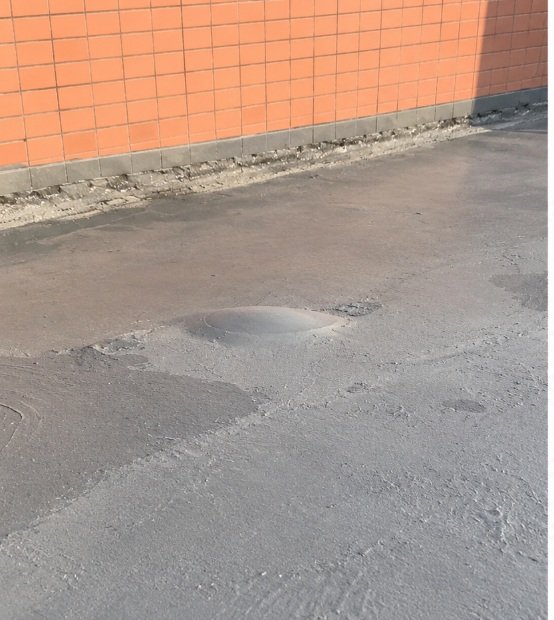
A waterproof coating blister on damp concrete is a common and costly coating failure. The coating may look sound immediately after application, only for raised, air-filled or liquid-filled bubbles to appear days or months later.
Blistering is not necessarily caused by the coating alone. It can result from moisture movement, vapor pressure, soluble salts, chemical reactions or inadequate adhesion at the concrete–coating interface. This guide explains the main mechanisms, how to assess substrate moisture and what to consider when selecting a waterproofing system.
Quick Answer: Key Takeaways
- Blisters can form when gas, vapor or liquid accumulates beneath a coating and the resulting pressure exceeds the local bond strength.
- Non-osmotic blisters are commonly associated with trapped air or vapor. Osmotic blisters involve water movement toward soluble material beneath a coating.
- Damp concrete is not automatically suitable or unsuitable for coating. The acceptable substrate condition depends on the specific waterproofing system and its technical data sheet.
- Binder selection, surface preparation and application conditions all affect coating performance. A wetting additive may help with wetting in a suitable formulation, but it does not replace moisture testing, contamination removal or system-specific validation.
1. What Is a Coating Blister?
A blister is a localized area where the coating loses adhesion and a pocket develops between the coating and the substrate. The pocket may contain:
- Gas or vapor, such as trapped air or water vapor; or
- Liquid, potentially containing dissolved salts or other soluble substances.
The coating lifts when the pressure in the pocket becomes greater than the local adhesion strength. Blisters may begin as small defects and become more visible as moisture, temperature or service conditions change.
2. Main Causes of Blistering on Damp Concrete
2.1 Vapor pressure from trapped moisture and air
Concrete is porous and contains both air and moisture. When a coating is applied, air or moisture in the pores may be trapped beneath a film that has begun to form. As the substrate warms, air expands and moisture may vaporize. If the coating cannot release the pressure quickly enough, localized blisters may develop.
Moisture moving through the slab while the coating is still wet or forming a film can also disrupt the wet film and contribute to pinholes or local adhesion defects.
2.2 Osmotic blistering
Osmotic blistering can occur when three conditions are present:
- A coating or interface that acts as a selective barrier;
- Water-soluble substances, such as salts or alkaline residues, concentrated beneath the coating; and
- Moisture available to move through the concrete or coating system.
Water can move toward the more concentrated solution beneath the coating. As liquid accumulates, pressure may build and lift the film. These blisters may contain liquid rather than air.
A moisture-vapor test alone does not rule out osmotic blistering. Soluble salts, surface residues and the condition of the interface may also need to be investigated.
2.3 Alkalinity and chemical reactions in concrete
Cementitious substrates are alkaline. Depending on the coating chemistry and the condition of the substrate, alkalinity and soluble residues may affect the coating or the bond line.
In some concrete systems, alkali–silica reaction (ASR) involving reactive aggregates can produce an expanding gel in the presence of moisture. Other factors, such as efflorescence, curing residues and contamination, can also affect the interface.
Do not assume that alkalinity is the cause of every blister. Confirm the likely mechanism through site inspection and appropriate testing.
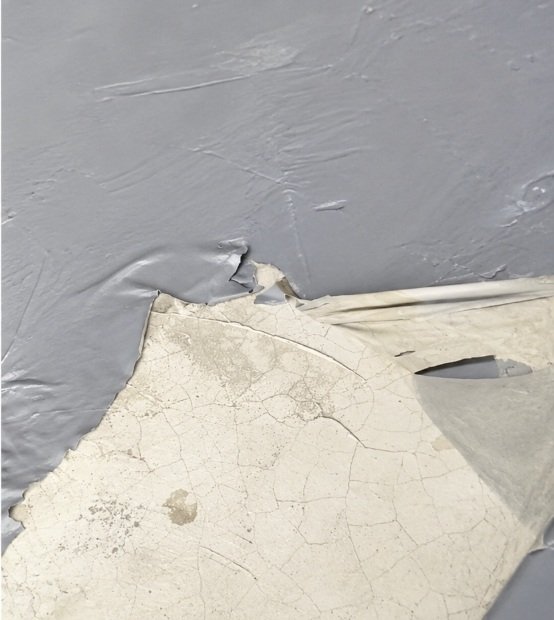
2.4 Poor adhesion at the interface
A weak or inconsistent bond can make blistering more likely, even where the moisture level is not unusually high. Common contributing factors include:
- Laitance, dust or loose particles left on the surface;
- Oil, grease, form-release agents or curing compounds;
- A smooth or over-trowelled surface that is not prepared as required by the coating system;
- Standing water or a substrate condition outside the coating manufacturer’s application requirements.
2.5 Application and curing mistakes
Application conditions can contribute to blistering. Examples include:
- Coating new concrete before it has reached the condition or curing age required by the system;
- Applying an excessively thick coat;
- Applying in hot, windy conditions that cause rapid surface skinning;
- Applying a subsequent coat before the previous coat has dried or cured sufficiently;
- Applying while substrate temperature is rising and air or moisture in the concrete is expanding.
Always follow the selected system’s application instructions rather than relying on a universal curing period or application limit.
3. Test Before You Coat: Moisture Assessment
Blister prevention starts with understanding the substrate condition. Common assessment methods include:
| Method | What it indicates | Important limitation |
|---|---|---|
| Plastic sheet test (ASTM D4263) | Qualitative indication of moisture beneath a taped plastic sheet | It is a screening method, not a quantitative measurement of slab moisture |
| Calcium chloride test (ASTM F1869) | Moisture vapor emission rate from the concrete surface | The result reflects the test conditions and is not a universal acceptance criterion for every waterproofing system |
| In-situ relative humidity test (ASTM F2170) | Relative humidity inside the concrete slab | The permitted RH depends on the coating system and project specification |
| Electronic moisture meter | Rapid comparative screening of surface moisture | Readings can be affected by the instrument, substrate composition and calibration |
There is no single moisture limit that applies to every waterproof coating. Values sometimes quoted for flooring systems should not automatically be treated as acceptance limits for liquid-applied waterproofing membranes. The controlling limits are those stated by the waterproofing-system manufacturer and the project specification.
Practical points:
- Use an appropriate test method. Select the method required by the system supplier or project specification; use screening methods as supporting information.
- Do not confuse moisture content with vapor emission. They measure different properties and are not interchangeable.
- A passing vapor test does not eliminate every blistering risk. Soluble salts, surface contamination, alkalinity and interface conditions may still matter.
- Make a representative trial area. Where the substrate or site conditions are uncertain, test the complete proposed system on the actual substrate before full application.
4. How to Select Materials to Reduce Blistering Risk
4.1 Waterproofing emulsion: select the binder for the system
The binder influences adhesion, film formation, flexibility and water resistance. When selecting an emulsion for concrete or cementitious waterproofing systems, assess the complete formulation and the intended application. Relevant selection factors include:
- Compatibility with cement in two-component polymer-cement systems;
- Alkali resistance under the intended service conditions;
- Film formation, including the minimum film-forming temperature (MFFT) and the site application temperature;
- Water resistance after curing, assessed in the complete formulation;
- Flexibility and elongation, where crack-bridging or movement accommodation is required;
- Moisture tolerance of the system. Do not infer suitability for application to damp concrete from general water resistance or alkali resistance; confirm the permitted substrate condition in the product TDS and system instructions.
JCT Chemical product options
For two-component polymer-cement waterproof coatings, JCT-2009 is described by JCT Chemical as an acrylic emulsion designed for this application. The product page lists good cement compatibility, alkali resistance and weather resistance.
JCT-2009 – typical published product data
| Property | Published value |
|---|---|
| Solid content | 55 ± 1% |
| pH | 7–9 |
| MFFT | Below 0°C |
For mastic-type waterproofing applications, JCT-2019 is another product option. Its published typical data include 48 ± 1% solid content, pH 7–9 and MFFT 22°C. Confirm suitability against the target formulation and application requirements.
- View JCT-2009 – acrylic emulsion for polymer-cement waterproof coatings
- View JCT-2019 – acrylic emulsion for mastic-type waterproofing
- View JCT Chemical waterproofing emulsion range
The figures above are typical values published on the product pages, not guaranteed batch specifications. Please request and check the latest TDS before formulation or production use. The published JCT-2009 information does not, by itself, establish that the product can be applied directly to damp concrete. Confirm the permitted substrate moisture condition with JCT Chemical’s technical team.
4.2 Wetting additive: evaluate wetting in the complete formulation
A wetting additive can help a coating spread and wet a substrate more evenly when the additive is suitable for the substrate and formulation. Its effect depends on the binder, pigment and filler package, dosage, substrate condition and application method.
JCT-WD110 is listed by JCT Chemical as a non-ionic wetting and dispersing additive intended for substrate wetting on low-energy surfaces. Its published product information is:
| Property | Published information |
|---|---|
| Active content | 100% |
| Ionic character | Non-ionic |
| Recommended dosage | 0.20–0.80% on total formulation |
Important application note: JCT-WD110 is described for low-energy-surface wetting. The published information does not specifically establish it as a concrete wetting additive or as an anti-blistering additive. If considering it for a cementitious or concrete waterproofing formulation, first confirm suitability with JCT Chemical and run compatibility, foam, water-resistance and application trials in the complete formulation.
A wetting additive should be treated as a formulation aid, not as a remedy for excessive substrate moisture, soluble salts, poor surface preparation or an unsuitable coating system.
5. Prevention Checklist
Before application
- Assess substrate moisture using the method required by the selected system.
- Check for efflorescence, soluble salts, contamination and surface condition.
- Confirm that the concrete has reached the curing condition required by the system.
- Identify and address the source of moisture, such as leaks, capillary rise, condensation or a missing vapor barrier.
Surface preparation
- Remove laitance, dust, oil, curing compounds and loose material using the preparation method specified for the system.
- Create the required surface profile and remove dust thoroughly.
- Use only the primer or bonding layer specified or approved for the selected waterproofing system.
Application
- Follow the manufacturer’s limits for substrate temperature, ambient temperature and moisture condition.
- Apply the specified wet-film or dry-film thickness. Avoid excessive thickness in a single coat.
- Respect recoat intervals and protect fresh coating from rain, condensation and other exposure until it has cured as instructed.
After application
- Inspect the coating after curing and after relevant heat or wetting cycles. Record the location and appearance of any defects for diagnosis.
6. Troubleshooting Guide
| Symptom | Possible cause | What to investigate |
|---|---|---|
| Air-filled blisters that appear during hot or sunny conditions | Trapped air or vapor expanding with heat | Substrate temperature, moisture movement, film thickness and application timing |
| Liquid-filled blisters | Possible osmotic action involving soluble substances | Fluid, soluble salts, surface residues, pH and the bond line |
| Blisters appearing weeks after application | Moisture movement, interface contamination or a chemical reaction | Reassess moisture, surface condition, salts and the concrete |
| Blisters near edges, joints or cracks | Water ingress, movement or local bond weakness | Joint detailing, cracks, water entry paths and adhesion |
| Pinholes or bubbles during film formation | Air release, moisture movement, foam or application conditions | Substrate condition, mixing, foam control, film thickness and application timing |
| Coating peels easily around a blister | Inadequate surface preparation or poor system compatibility | Surface preparation, primer selection and adhesion testing |
These symptoms are diagnostic clues, not definitive diagnoses. Confirm the cause before changing the formulation or application method.
7. Why Work with JCT Chemical?
JCT Chemical supplies waterproofing emulsions and functional additives for coating formulators. The team can help customers review binder and additive options, request technical data and arrange samples for laboratory evaluation.
For a more useful technical assessment, provide the following information when making an inquiry:
- The intended waterproofing system (for example, two-component polymer-cement or mastic);
- Concrete age and substrate condition;
- Moisture-test method and results, if available;
- Current formulation or binder type;
- Photos of the blistering or other coating defect.
Working on a waterproof coating that is blistering? Share the application details and defect photos with our team so that the likely causes and suitable material options can be reviewed.
- Request a sample or technical support
- Contact the JCT Chemical team
- Explore JCT waterproofing emulsions
Working on a Waterproof Coating That Is Blistering?
Share your formulation, substrate details and defect photos with JCT Chemical. Our team can help review the likely causes and discuss suitable material options.
Frequently Asked Questions
Why does a waterproof coating blister on damp concrete?
Blistering can occur when air, vapor or liquid accumulates beneath the coating and creates pressure greater than the local bond strength. Possible contributors include moisture movement, soluble salts, interface contamination, chemical reactions and application conditions.
What is osmotic blistering?
Osmotic blistering involves water moving toward a concentrated solution of soluble substances beneath a coating or at the coating–substrate interface. The resulting liquid pressure can lift the coating.
How dry should concrete be before waterproofing?
There is no single moisture limit for all waterproofing products. The acceptable condition depends on the specific coating system, test method and project specification. Follow the manufacturer’s TDS and application instructions.
Can a wetting additive prevent blistering?
A suitable wetting additive may improve spreading or substrate wetting in a compatible formulation. It does not correct excessive moisture, soluble-salt contamination, poor surface preparation or an unsuitable coating system. Do not describe an additive as an anti-blistering solution unless this is supported by relevant test data.
How long should new concrete cure before coating?
The required curing period depends on the concrete and the waterproofing system. Some systems specify a conventional curing period, while others may allow different conditions. Follow the product TDS and project specification rather than applying a universal number of days.
Does passing a moisture-vapor test guarantee that blisters will not form?
No. A moisture-vapor test evaluates a particular aspect of substrate moisture. It does not rule out soluble salts, contamination, chemical reactions, poor adhesion or application-related causes.
References and Further Reading
- ASTM D4263 – indication of moisture in concrete by the plastic sheet method.
- ASTM F1869 – measurement of moisture vapor emission rate of concrete subfloor using anhydrous calcium chloride.
- ASTM F2170 – determination of relative humidity in concrete floor slabs using in-situ probes.
Always consult the current ASTM standards and the waterproofing-system manufacturer’s requirements for the applicable test procedure and acceptance criteria.
Product figures are typical published values and may vary. Refer to the latest official TDS and validate performance in the intended formulation and project conditions. Product selection does not replace substrate assessment, system design or on-site trials.