
Technical Guide
Why Does Water-Based Wood Paint Lose Adhesion?
A practical guide to substrate preparation, surface wetting, binder selection, film formation, drying conditions and internal film stress in water-based wood coatings.
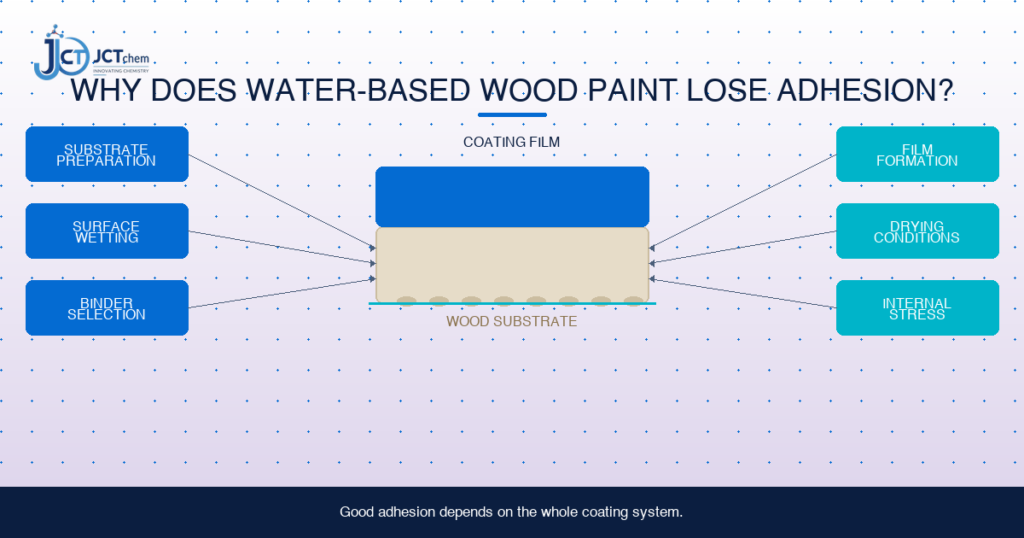
A water-based wood coating may look perfectly fine immediately after application — but weeks or months later, the film may begin to peel, crack or lose adhesion. When that happens, the binder is usually the first suspect, yet adhesion failure is rarely caused by the polymer alone. In water-based wood coatings, the final adhesion result depends on the condition of the substrate, how well the liquid coating wets the surface, whether the selected polymer suits the system, whether a continuous film actually formed under real drying conditions, the stresses locked inside the film, and how primer and topcoat layers interact with each other. This guide walks through each factor in the order a formulator would typically investigate it, and closes with a troubleshooting framework and a systematic optimization sequence.
Wood condition, moisture, sanding quality and cleanliness set the baseline for everything that follows.
A film can only adhere to what it actually touches. Wetting determines the true contact area.
Acrylic, PUA and PUD technologies answer different requirements — and grades within one family are not interchangeable.
A good emulsion still needs the right temperature, humidity and drying time to coalesce on real wood.
01Why Does Adhesion Fail on Wood?
Unlike metal or glass, wood is not an inert, uniform substrate. It is a natural, porous, hygroscopic material whose surface chemistry and structure vary not only between species but also between boards cut from the same tree. Several substrate characteristics influence how a water-borne coating anchors to it:
- Wood species and density
- Porosity and pore structure
- Surface roughness after sanding
- Natural oils and resins (extractives)
- Moisture content
- Sanding quality and dust
- Surface contamination
- Previous coating layers
Oily tropical species, resinous softwoods and dense hardwoods each present different wetting and penetration behavior. A formulation that performs well on beech test panels may behave differently on oak, pine or a resin-impregnated board — not because the coating changed, but because the substrate did. For the same reason, no single preparation method is universally suitable for every wood substrate: preparation has to be matched to the species, the surface history and the coating system.
The practical consequence is important: when adhesion fails, the explanation is rarely a single cause. It is usually the weakest link in a chain that runs from the wood surface, through the wetting and film-formation process, to the finished film and its internal stress state.
02Substrate Preparation: The First Point to Check
Before any formulation variable is changed, the substrate deserves a disciplined review. Sanding quality determines the microscopic surface profile the coating can anchor to; dust left on the surface becomes a weak boundary layer; oils, waxes and silicone contamination from polishing or machining interfere with wetting; and a moisture content outside the range appropriate for the application means the wood will continue to move after coating.
Previous coating layers deserve equal attention. A water-based topcoat applied over an old finish, a partially cured factory primer or an incompatible sealer may fail at that interface even when the new coating is well formulated. In many cases, poor substrate preparation creates an apparent “binder problem” — the polymer is blamed for failures that the substrate condition actually caused.
- ✓ Surface clean — no oil, wax, silicone or dust
- ✓ Appropriate sanding for the species and coating
- ✓ Dust removed before application
- ✓ Moisture condition controlled
- ✓ No incompatible contamination
- ✓ Previous coating layer evaluated for compatibility
Where any of these points is uncontrolled, the first corrective action is on the process line, not in the formulation.
03Surface Wetting and Coating/Substrate Contact
Adhesion can only be established where the coating is in genuine contact with the wood. Wetting describes how the liquid coating spreads over and into the surface micro-structure, and it is governed by the relationship between the surface tension of the coating, the surface energy of the substrate, and the rheology of the liquid — how it flows into pores and micro-scratches rather than bridging over them.
Insufficient wetting reduces the effective contact area: the film bridges over pores, entraps air, and adheres only at the high points of the surface profile. On woods rich in natural oils, the problem can be more pronounced because low-energy extractives sit directly in the interface zone.
Wetting and dispersing additives can improve contact on difficult surfaces, and where pigmented systems are involved they also support pigment wetting and color stability. Their effect should not be overstated, however: additives improve the contact that the binder system is capable of making — they cannot compensate for a fundamentally unsuitable binder/substrate combination.
04Binder Selection Matters — But “Acrylic” Is Not a Single Performance Category
Water-based wood coatings are built on several polymer families, most commonly acrylic emulsions and polyurethane dispersions (PUD), including polyurethane-acrylic hybrids (PUA). None of these technologies is universally superior. Different polymer types suit different coating requirements, and the correct comparison is never “acrylic versus PUD” in the abstract — it is a specific grade against a specific performance target in a specific system.
Binder selection for a wood coating typically weighs the complete performance profile:
- Adhesion to the target substrates
- Hardness / flexibility balance
- Film formation capability
- Water resistance
- Blocking resistance
- Scratch and abrasion resistance
- Chemical resistance
- Substrate compatibility
- Feasible drying conditions
It is equally important to understand that even within one family, “acrylic” is not a single performance category. Polymer design variables — monomer composition, Tg, particle morphology, particle size distribution and molecular architecture — plus the formulation built around them, can produce acrylic emulsions with very different adhesion, hardness and film-formation behavior. Two acrylic emulsions with similar solids content can behave completely differently on the same wood. This is why grade-level evaluation, rather than chemistry-level assumptions, is the reliable basis for selection.
Neither technology is a universal answer: a PUD is not automatically “better” than an acrylic emulsion, and vice versa. The binder must match the coating type — primer, sealer or topcoat — and the full performance target.
05Film Formation: Why a Good Emulsion Can Still Produce Poor Adhesion
Water-based coatings do not arrive as continuous films — they become films after application. The polymer is supplied as discrete particles dispersed in water, and only during drying do these particles pack together and coalesce into a continuous phase. That process depends on the minimum film formation temperature (MFFT) of the dispersion relative to the actual application conditions, the evaporation rate of the water, the film thickness, and the temperature of the substrate — which can be several degrees below ambient air temperature.
If the polymer does not form a sufficiently continuous film under the real conditions on the line, the coating is adhesively “patchy” at the microscopic level: polymer reaches the wood in some regions and not in others. The film may still look acceptable, but its adhesion, cohesion and water resistance are all reduced. High humidity, cold substrates, excessive film thickness and forced drying that skins the surface before coalescence is complete are typical aggravating factors.
This is why a formulation that performs well in laboratory trials can fail in a cold workshop or on a high-speed line: the emulsion did not change — the film formation conditions did.
06Drying Conditions Can Change the Final Result
The conditions under which the water leaves the film matter as much as the polymer itself. The main variables to control and record are:
- Ambient and substrate temperature
- Relative humidity
- Ventilation and air movement
- Drying time before handling or stacking
- Substrate moisture
- Coating thickness per layer
“Dry to touch” is not a performance state. It only means the surface has lost enough water to resist light contact. Water-based wood coatings typically continue developing hardness, coalescence and wet adhesion for hours to days after application, depending on the system. Testing adhesion too early — or stacking freshly coated panels under warm, humid conditions — can produce failures that the same system would not show after a full drying cycle.
In production troubleshooting, the drying history of failed panels is therefore one of the first records to request. A failure that appears only on panels dried on a particular line, in a particular season, or at a particular time of day usually points to conditions rather than to the coating formula.
07Internal Stress and Film Flexibility
As a water-based film dries, it shrinks: water leaves, particles coalesce, and the film wants to contract over a substrate that does not. The result is internal stress. Wood adds a second stress source — it swells and shrinks with moisture, seasonally and daily, in a direction-dependent way. The coating has to survive this movement for years.
An overly hard, highly filled or very thick film concentrates this stress at the wood–coating interface, and the film eventually cracks or detaches. But the common simplification — “softer coatings adhere better” — is wrong. A film that is too soft may show poor blocking resistance, poor dirt pick-up resistance and insufficient protection. What the formulation needs is a suitable balance between hardness, flexibility and adhesion for the intended application: a kitchen cabinet front, a floor and a garden gate do not share the same optimum.
08Primer / Topcoat Compatibility
Most industrial wood coatings are multi-layer systems, and adhesion has to be evaluated at every interface — not only between wood and primer:
A coating can adhere well to the wood yet fail between coats. Common contributors include recoating outside the recommended recoat window (too early on insufficiently dried layers, or too late onto a fully hardened, unsanded surface), intercoat contamination, incompatibility between binder systems from different suppliers, and over-sanding a primer that relies on a limited sanding allowance.
Where a failure occurs between layers rather than at the wood surface, the investigation should focus on layer compatibility, surface condition before recoating, sanding between coats where required, and the drying/curing state of each layer — before any change to the formulation itself is considered.
09Common Adhesion Failure Symptoms
The location and timing of an adhesion failure carry diagnostic information. The table below summarizes frequently observed symptom patterns and the factors commonly associated with them — as investigation starting points, not as definitive diagnoses.
| Symptom | Possible Factors | What to Check |
|---|---|---|
| Peeling from the wood surface | Possible factors include substrate contamination, poor wetting, an unsuitable binder for the substrate, or incomplete film formation. | Substrate preparation records, wetting behavior on the actual wood, film formation conditions. |
| Peeling between coating layers | Possible factors include intercoat incompatibility, recoating outside the recoat window, or intercoat contamination. | Layer compatibility, surface condition before recoating, drying state of the underlying layer. |
| Good dry adhesion but poor wet adhesion | Possible factors include incomplete film formation, water-sensitive components in the formulation, or testing before properties fully developed. | Water resistance testing, drying history, re-testing after full property development. |
| Adhesion varies between wood species | Possible factors include porosity differences, natural extractives, and surface energy variations between substrates. | Testing on the representative production substrates rather than only on standard panels. |
| Adhesion worse in cold or humid periods | Possible factors include film formation below the dispersion’s requirements, and slowed drying under high humidity. | Ambient and substrate temperature records, humidity, drying times before stacking. |
Symptom patterns indicate where to start looking — confirmation requires controlled testing.
10A Practical Troubleshooting Framework
When an adhesion problem reaches the laboratory, a fixed investigation order prevents the most common mistake: changing several variables at once and never learning which one mattered. The sequence below follows the physical path of the coating from the wood surface outward.
Change one major variable at a time whenever possible. Multiple simultaneous changes make the cause of an improvement — or a failure — impossible to attribute.
11How to Improve Adhesion Systematically
Troubleshooting is reactive; formulation development should be structured. The sequence below organizes the factors in this guide into a development order in which each stage defines the constraints for the next.
Reading the framework from the top: the substrate and application method determine what “good adhesion” must survive; the performance target determines the polymer family and grade; wetting and film formation decide whether that polymer can actually perform on the line; and the final stages confirm the result on representative wood — the only substrate that ultimately matters.
12Testing Adhesion
Adhesion should not be judged by appearance. A film can look uniform and well attached while a cross-cut test reveals marginal interfacial strength — and the reverse can occur after water exposure. A structured evaluation typically combines several complementary methods:
| Evaluation | What It Shows |
|---|---|
| Cross-cut / cross-hatch testing | Comparative dry adhesion and cohesive strength near the interface; a standard workshop-level screening method. |
| Pull-off testing, where appropriate | Quantitative tensile adhesion strength; useful where a number is needed for specification or comparison. |
| Wet adhesion testing | Whether the interface maintains strength after water exposure — frequently where marginal systems fail. |
| Water immersion or exposure | Water sensitivity of the film and the interface, including blistering and re-wetting behavior. |
| Repeated humidity exposure | Behavior under cyclic moisture conditions, closer to real service for furniture and joinery. |
| Representative substrate testing | Whether results obtained on test panels transfer to the production substrates and species. |
Test methods should be agreed between supplier and customer. Results depend on film thickness, drying history, substrate and conditioning — record all of them.
Two practical rules save time and disputes: test each layer of a multi-layer system, not only the complete stack; and test after the full property development time, not at the earliest moment the film appears dry.
13JCT Solutions for Water-Based Wood Coating Formulation
JCT Chemical supplies water-based raw materials for wood coating systems across several polymer technologies — acrylic dispersions, two-component acrylics, cationic acrylics, polyurethane-acrylic hybrids (PUA), polyurethane dispersions (PUD), waterborne UV-curable dispersions and functional additives. The same polymer families also support other water-based applications: see acrylic resins, polyurethane dispersions and acrylic waterproofing emulsions. The grades below are selected from the JCT wood coatings portfolio as formulation starting points relevant to the factors discussed in this guide; the complete portfolio, including cationic and UV-curable options, is presented on the application page.
JCT-614
Waterborne acrylic dispersion for wood primers, topcoats and sealing primers, with high transparency, good penetration and sanding properties, good water resistance and a warm-wood effect.
Typical product characteristics — refer to the official TDS for current specifications.
JCT-640
Hydroxyl-functional acrylic for two-component wood primers, topcoats and sealers, with fast hardness development, a long pot life, and good water resistance and adhesion in 2K systems.
Typical product characteristics — refer to the official TDS for current specifications.
JCT-105U
Polyurethane dispersion with good water resistance and very high transparency, good warm-wood effect and high build; can be combined with isocyanate crosslinkers for highly water-resistant matt coatings.
Typical product characteristics — refer to the official TDS for current specifications.
JCT-S34
Wetting and dispersing additive for primers, tinting paints and pigmented systems; improves wetting of organic and inorganic pigments and helps maintain color stability.
Typical product characteristics — refer to the official TDS for current specifications.
Explore the Full Wood Coatings Portfolio →
Because adhesion is system-dependent, the practical route is to define your substrate, application method and performance target first — then evaluate candidate grades in your own formulation, on your production substrates, under your drying conditions. JCT’s technical team supports this evaluation with product documentation and samples.
14Related JCT Application: Water-Based Wood Coatings
Water-Based Wood Coatings
Explore JCT’s polymers and additives for water-based wood paints — primers, sealing primers, intermediate coats and topcoats for furniture, joinery and interior wood applications, across acrylic, 2K acrylic, cationic, PUA and PUD technologies.
Technical Summary
“Good adhesion starts at the wood–coating interface, but it depends on the whole coating system.”
Related Guides
15FAQ
Why does water-based wood paint lose adhesion after drying?
Adhesion loss after drying is rarely caused by the binder alone. Possible factors include inadequate substrate preparation, contamination, poor wetting of the wood surface, incomplete film formation under the actual drying conditions, internal stress in an unbalanced film, and intercoat incompatibility in multi-layer systems. A systematic check of each of these factors usually identifies the limiting one.
Does better wetting always improve adhesion?
No. Wetting is necessary for establishing contact between the coating and the wood, but it is not sufficient on its own. A coating can wet a surface well and still fail because of film formation problems, internal stress or an unsuitable binder. Wetting and dispersing additives can improve contact on difficult surfaces, but they cannot compensate for a fundamentally unsuitable binder/substrate combination.
Can acrylic emulsions be used for wood coatings?
Yes. Acrylic emulsions are widely used in water-based wood primers and topcoats. However, “acrylic” is not a single performance category: polymer design, Tg, particle structure, composition and the surrounding formulation all influence how a specific grade behaves on wood. Grade selection should be matched to the coating type and performance target, and verified by testing.
When should I consider a PUD instead of an acrylic emulsion?
There is no universal ranking between the two technologies. Polyurethane dispersions and acrylic emulsions offer different balances of hardness, flexibility, chemical resistance and film formation. A PUD or PUA hybrid may be worth evaluating when the required balance of hardness and flexibility, or specific surface feel and chemical resistance, is difficult to achieve with the acrylic grades available. The choice should be made against the complete performance target, not against a single property.
Why does adhesion differ between different wood species?
Wood species differ in porosity, density, surface energy and natural extractives such as oils and resins. Oily species can be harder to wet, and dense, fine-pored species offer less mechanical anchoring. The same coating can therefore behave differently on different substrates. Testing on the representative production substrates — not only on test panels — is the reliable way to account for this.
Can poor film formation cause adhesion problems?
Yes. If the application temperature, humidity or film thickness does not allow the polymer particles to coalesce into a continuous film, adhesion is only established where polymer actually reaches and conforms to the wood surface. A coating that looked acceptable at application can fail later for this reason. Checking the relationship between the emulsion’s minimum film formation temperature and the real drying conditions is a standard diagnostic step.
How should adhesion problems be troubleshot?
Work through the system in a defined order: substrate condition, surface wetting, binder suitability, film formation, drying conditions, formulation balance, and intercoat compatibility — then re-test under controlled conditions. Change one major variable at a time whenever possible, so that the effect of each change can be attributed correctly.
Looking for a Suitable Polymer or Additive for Your Water-Based Wood Coating System?
Tell us your substrate, application method and performance requirements. Our technical team can recommend suitable JCT grades and provide technical information for evaluation — before any product is committed to.