
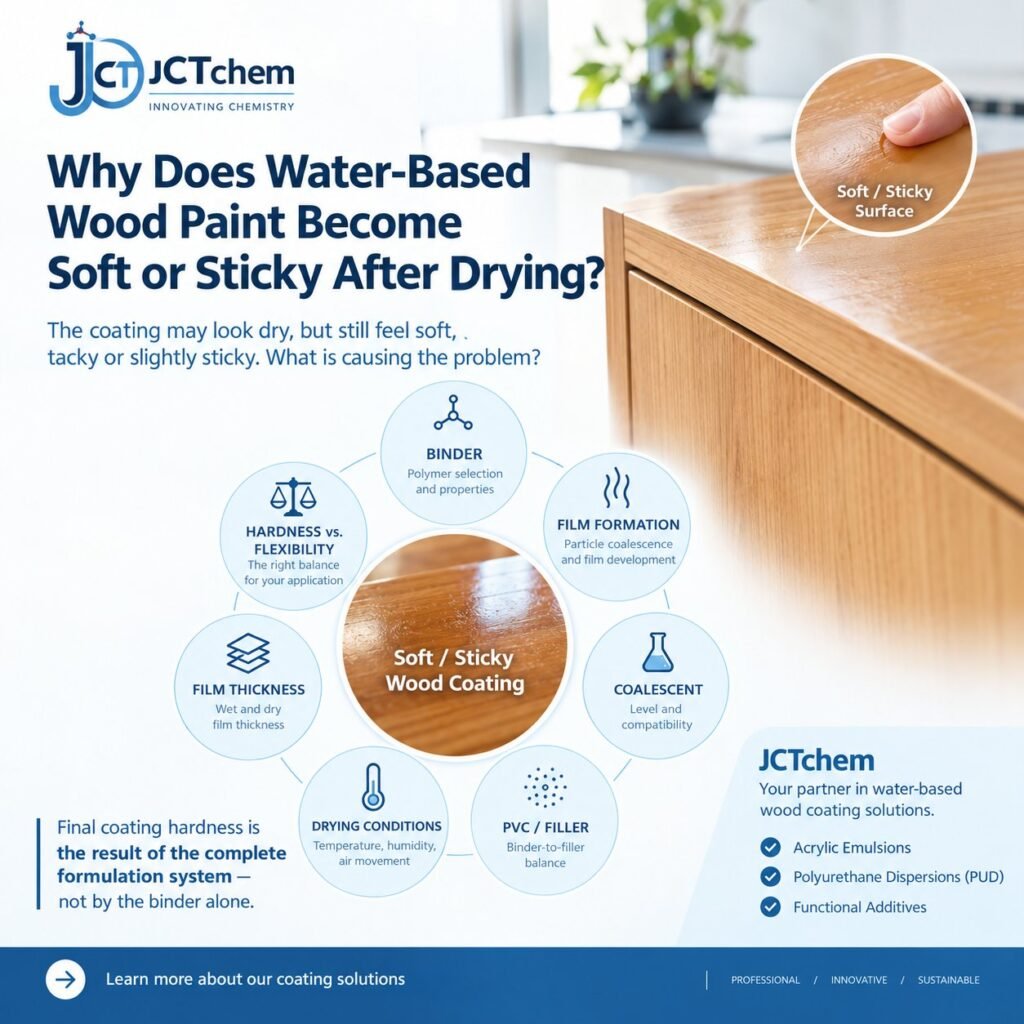
Why Does Water-Based Wood Paint Become Soft or Sticky After Drying?
A practical guide to binder selection, film formation, coalescent balance, PVC and filler loading, drying conditions, film thickness and the hardness–flexibility balance in water-based wood coatings.
The coating looks dry — but the surface still feels soft, tacky or slightly sticky. When a water-based wood coating refuses to develop the hardness a formulator expects, the binder is usually the first suspect, yet the polymer alone rarely explains the result. Final coating hardness is determined by the complete coating system: the binder and its Tg/MFFT profile, whether the film actually coalesced under real conditions, the coalescent balance, the PVC and filler loading, the drying environment, the applied film thickness, and the hardness–flexibility balance the application genuinely requires. This guide walks through each factor in the order a formulator would typically investigate it, and closes with a troubleshooting checklist, a systematic optimization sequence and a testing framework.
Polymer hardness, Tg and MFFT set the ceiling for what the film can become — softness is often designed in before the first coat is applied.
A dry-to-touch surface can still hide unfused polymer particles, residual water and incomplete film development underneath.
Coalescent level and PVC / filler loading decide whether the binder can build a continuous, cohesive film.
Temperature, humidity, air movement, film thickness — and knowing how much hardness the application truly needs.
01Dry to the Touch Does Not Always Mean Fully Developed Film Properties
The coating looks dry, but the surface still feels soft or slightly sticky. What is causing the problem?
It is tempting to read “dry to the touch” as “finished” — but in a water-based system, surface dryness is only the first milestone in a longer physical process. What the fingertip detects is the state of the topmost microns of the film; it says little about the state of the film as a whole. When a water-based wood coating remains soft or tacky, the explanation is not necessarily that the drying time was too short. Any combination of the following may be involved:
- Binder / polymer selection (Tg, MFFT, polymer hardness)
- Film formation and particle coalescence
- Coalescent balance in the formulation
- PVC and filler loading
- Drying conditions (temperature, humidity, air movement)
- Coating thickness per layer
- Hardness vs. flexibility balance of the system
In a water-based wood coating, several processes overlap in time: water evaporates from the surface, particles pack together, particles coalesce into a continuous polymer phase, and the film then continues to develop its final properties — cohesiveness, hardness, blocking resistance — over hours to days depending on the system. A surface can be dry while the interior is still releasing water, still fusing, or permanently unable to fuse because the conditions never allowed complete coalescence.
A useful habit for troubleshooting is therefore to separate three questions: when was the coating tested, where in the film was it tested, and what the film was actually built from. A coating judged “too soft” one hour after application may be entirely acceptable after a full property development cycle — and a coating that is still soft after several days deserves a formulation-level investigation rather than more patience.
02Binder or Polymer Selection
The polymer is the largest single contributor to final film hardness — but it is a starting point, not a verdict. Three binder characteristics matter most for the soft/sticky question:
- Polymer hardness — how rigid the polymer phase itself is once the film is fully formed
- Tg (glass transition temperature) — the temperature above which the polymer is soft and rubbery rather than glassy and rigid
- MFFT (minimum film formation temperature) — the lowest temperature at which the dispersion can still form a continuous, crack-free film
These properties are related but not interchangeable. A dispersion with a low Tg polymerizes as a soft, flexible phase; the same polymer gives films that feel softer, show lower scratch resistance and may show limited blocking resistance. A low-Tg, low-MFFT binder is deliberately designed for flexibility, crack resistance and reliable coalescence in cold workshops — valuable properties for a coating on wood, which swells and shrinks with moisture. Softness in such a system is not a defect of the binder; it is a design consequence that must be matched to the application.
Conversely, a harder, higher-Tg polymer can support:
- Higher surface hardness
- Better blocking resistance
- Better scratch and mar resistance
…but pushing hardness too far in a wood coating can bring:
- Brittleness and cracking risk
- Poor flexibility over a moving substrate
- A higher MFFT, which narrows the application window and makes film formation more demanding
Neither end of the hardness spectrum is “better”. A film that is too soft shows blocking, printing and dirt pick-up problems; a film that is too hard cracks over moving wood and demands impractical drying conditions. The binder must be selected for the specific coating type — primer, sealer or topcoat — and the specific performance target.
It also matters that “acrylic” is not one material. Monomer composition, particle morphology and molecular architecture differ between grades, so two acrylic emulsions of similar solids can produce films of noticeably different hardness, feel and blocking behavior. Grade-level evaluation — not chemistry-level assumptions — is the reliable basis for binder selection. The same applies across technologies: acrylic emulsions, polyurethane dispersions (PUD) and polyurethane-acrylic hybrids (PUA) each offer different hardness–flexibility–film-formation balances, as described in the JCT wood coatings portfolio.
03Incomplete Film Formation
Film formation is where many genuinely soft films are made. Water-based binders are supplied as discrete polymer particles dispersed in water; hardness, cohesion and blocking resistance only develop after those particles have packed and fused into a continuous phase. If coalescence is incomplete, the film is literally made of loosely bonded particles — and no amount of drying time will turn a powdery or soft particle mosaic into a hard polymer glass.
Common contributors to incomplete film formation include:
- Application or substrate temperature below the dispersion’s film formation requirements
- High relative humidity slowing water removal
- Insufficient coalescence time or too-rapid skin formation at the surface
- An inappropriate coalescent level for the polymer and conditions
- Poor compatibility between formulation components
- A polymer whose MFFT is unsuitable for the real drying environment
When film formation is the limiting factor, the consequences reach beyond softness. A partially coalesced film typically also shows poor water resistance, weak cohesion, poor blocking resistance and reduced durability — the same polymer, fully coalesced, would deliver measurably better results. This is one of the most common ways a “bad batch of resin” accusation turns out to be a workshop temperature problem instead.
A note of caution: not every soft film is a film-formation failure, and not every film-formation failure is caused by the coalescent. Temperature, humidity, film thickness and the polymer’s own MFFT all participate. The coalescent is one lever in the system — not the universal explanation.
04Coalescent and Formulation Balance
Coalescents exist to temporarily soften the polymer particles so they can fuse at temperatures where they otherwise could not. Getting the balance right is a genuine formulation task, because both directions fail:
- Too little coalescence support — particles cannot fuse under the available drying conditions; the film stays soft, weak and water-sensitive
- Excessive or inappropriate coalescent — the film remains plasticized for longer; early hardness, surface feel and blocking resistance can be affected, and the surface may feel tacky
- Poor compatibility — an unmatched coalescent can migrate, exude or cause surface defects instead of helping fusion
The coalescent must therefore be matched to the polymer it is supposed to soften, to the drying conditions the film will actually experience, and to the properties the finished coating must reach. What that means in practice is system-specific: the requirement depends on the binder’s Tg and MFFT, the applied film thickness, the drying environment and the time available before the coated parts must be handled or stacked. Rather than searching for a universal level, formulators verify the balance empirically — by checking hardness development and blocking behavior on their substrates, under their conditions, at their film builds.
There is no universally correct coalescent level for water-based wood coatings. The right balance is the one that delivers complete film formation and acceptable hardness development in the actual production environment — and it can only be confirmed by testing in that environment.
05PVC and Filler Loading
Pigment volume concentration — the ratio of pigment and filler volume to total dry film volume — quietly shapes how hard a coating can become. Polymer is what carries hardness, cohesion and blocking resistance; fillers occupy volume. As filler loading rises, the binder has progressively less polymer per unit of surface and volume to work with.
Excessively high filler loading can contribute to:
- Lower binder continuity through the film
- Weaker film cohesion and surface durability
- Poorer water resistance
- Reduced smoothness and surface feel
- A softer or more powdery surface, especially with soft-fillers or over-extendered matte systems
The opposite extreme is not an answer either. Filler systems are not simply “less filler is better”: a properly designed filler package supports cost control, opacity, sanding behavior, rheology and matting — properties that a pure binder film would deliver poorly or expensively. The engineering question is the binder-to-filler balance: enough polymer to build a continuous, cohesive film with the required hardness and blocking resistance, and enough filler to meet the optical, rheological and economic targets of the product.
06Drying Conditions Matter
The same formulation can produce different hardness results in the laboratory and on the furniture line, because the film responds to the environment it dries in. The main variables to control and record are:
- Ambient temperature and substrate temperature
- Relative humidity
- Air movement over the coated surface
- Drying time before handling, stacking or testing
- Number of coats and interval between coats
The combination that most reliably delays hardness development is low temperature + high humidity + low air movement: water leaves the film slowly, the surface skins over, and the remaining water must diffuse through an increasingly dense polymer layer. The film then reaches “dry to the touch” late — or reaches it superficially while the bulk of the film is still developing.
Substrate temperature deserves particular attention. A panel coming out of a cold warehouse, or a workshop floor in winter, can sit several degrees below the air temperature measured at head height — and it is the substrate, not the room, that the first microns of film dry against. A dispersion whose MFFT is suitable for the workshop’s average day may still fail to coalesce fully on its coldest days, which is one reason soft-film complaints often arrive seasonally.
- ✓ Substrate temperature recorded, not only air temperature
- ✓ Relative humidity logged for the actual drying period
- ✓ Air movement sufficient for water removal
- ✓ Stacking / packaging delayed until properties have developed
- ✓ Seasonal variation considered for unconditioned workshops
07Coating Thickness Can Change the Result
A thicker wet film contains more water and more polymer per unit area, and both must make their way out or fuse in place. The result is a stratified drying pattern:
For the formulator, this means four numbers belong in every trial record: wet film thickness, dry film thickness, drying time to a defined state, and number of coats. Comparing hardness results between trials taken at different film builds is not a like-for-like comparison — and specifying the applied build is part of specifying the coating.
08Hardness and Flexibility Need to Be Balanced
This is the central engineering point of the soft/sticky question: wood coating hardness is not a one-dimensional optimization. Pushing hardness to the maximum eventually costs flexibility, crack resistance and film formation reliability; staying too soft costs blocking resistance, scratch resistance and surface durability. The table below summarizes the trade-offs a formulator navigates:
| Property | Too Soft | Balanced | Too Hard |
|---|---|---|---|
| Flexibility | High | Balanced | Lower |
| Scratch Resistance | May be limited | Application-dependent | Potentially higher |
| Blocking Resistance | May be limited | Better balanced | Potentially better |
| Crack Resistance | Potentially better | Balanced | May decrease |
| Film Feel | Soft / tacky | Application-dependent | Hard / rigid |
Directional trade-offs only — the actual balance point depends on the coating system and end use.
The right balance depends on the end-use application, the substrate and the complete coating system. A kitchen cabinet front, a window frame, a floor and a decorative interior panel do not share the same optimum — and even within furniture, a soft-touch aesthetic coating and a durable tabletop coating pull the formulation in opposite directions. Defining the performance target before optimizing hardness prevents the most common mistake in this space: solving a softness problem by creating a cracking problem.
09Substrate and Application Method Also Matter
The final measured hardness of a wood coating is influenced by what lies beneath it and how it was applied:
- Wood species and density
- Substrate porosity — a coating that soaks into an open-pored surface shows a different surface hardness than one sitting on a sealed, sanded base
- Sanding quality and surface profile of the previous layer
- Primer type and primer/topcoat system design
- Number of coats and film build per coat
- Application method — spray, brush or roller, each laying down a different wet film
Wood is not an inert, uniform substrate. Different species, different boards and different surface preparations produce different results with the same coating — and porous or unevenly sanded surfaces can make a properly formulated topcoat feel softer or less uniform simply because the film’s effective thickness varies across the surface. When hardness complaints vary between parts or between batches of substrate, the substrate belongs high on the investigation list.
10Practical Troubleshooting Checklist
The table below maps the most frequently observed symptoms to the factors commonly associated with them. Treat it as a set of investigation starting points — not as definitive diagnoses, because several of these symptoms share causes and confirmation always requires controlled testing.
| Symptom | Possible Causes | What to Check |
|---|---|---|
| Surface remains soft | Binder too soft for the application, or insufficient film formation under the actual conditions. | Tg and MFFT of the dispersion vs. real drying temperature; film formation conditions. |
| Surface feels tacky | Incomplete drying, or a coalescent imbalance keeping the surface plasticized. | Humidity and temperature records; drying time; coalescent level and match to the polymer. |
| Poor blocking resistance | Low polymer hardness, or incomplete film development when parts were stacked. | Polymer selection; time allowed before stacking; hardness development over time. |
| Soft film with high filler loading | Insufficient binder continuity through the film. | Binder-to-filler balance; whether the PVC matches the product type and target. |
| Good initial hardness but poor flexibility | Film too rigid for the substrate and end use. | Polymer selection; hardness–flexibility balance vs. the real performance target. |
| Hardness develops very slowly | Thick film, slow drying, or low temperature / high humidity conditions. | Film thickness per coat; air movement; temperature and humidity during drying. |
Symptom patterns indicate where to start looking — confirmation requires controlled testing.
11How to Improve Hardness in Water-Based Wood Coatings
When the decision is made to improve hardness, a fixed investigation order prevents the most common development mistake: swapping one raw material, seeing a different result, and attributing the change to that swap alone. The sequence below works from the polymer outward to the complete system:
Do not change one raw material and judge the result in isolation. Hardness is a system property — a new binder evaluated at the old film build, in the old drying environment, on the old substrate, tells you little about how it will behave in the corrected system.
12Recommended Testing
Hardness complaints should be settled with structured evaluation, not with fingertips. A complete assessment of a water-based wood coating typically combines several complementary methods:
| Evaluation | What It Shows |
|---|---|
| Surface hardness | How the finished surface responds to contact — the property the customer perceives as “hard” or “soft”. |
| Pencil hardness | A comparative screening method for film hardness, widely used for quick formulation comparisons. |
| Blocking resistance | Whether stacked coated surfaces stick to each other under pressure — often the real complaint behind “sticky”. |
| Scratch resistance | Surface durability against abrasion and scuffing in handling and service. |
| Drying time | How quickly defined dry states are reached — and whether the process window is realistic for production. |
| Water resistance | Whether the film withstands water contact, including surface changes after exposure. |
| Adhesion | That hardness was not bought at the cost of bonding to the substrate and intercoat layers. |
| Wet adhesion, where applicable | Interface strength after water exposure — relevant for kitchen, bathroom and exterior wood. |
Depending on the application, manufacturers may use standardized laboratory methods or internal testing protocols to evaluate these properties.
Two disciplines make the results meaningful: test at a defined time after application (not at the earliest moment the film appears dry), and record the film thickness, substrate and drying history alongside every result. Hardness numbers without context are not comparable — between laboratories or even between batches of panels. For the related failure mode where films detach instead of staying soft, see our companion guide: Why Does Water-Based Wood Paint Lose Adhesion?
13From Binder Selection to Finished Wood Coating
Most soft or sticky wood coatings are not solved by a single ingredient — they are solved by aligning the binder, the film formation conditions, the formulation balance and the application around one performance target. That is the support JCT Chemical provides to water-based wood coating development:
Waterborne acrylic dispersions for wood primers, sealers and topcoats, spanning different hardness, flexibility and film formation requirements — from easy-coalescing, flexible grades to hard, fast-blocking systems. See the acrylic resins range for wood-relevant dispersions.
Polyurethane dispersions and PUA hybrids for applications requiring enhanced surface performance and mechanical properties, depending on formulation — including high-hardness and fast hardness development options. See the polyurethane dispersions range.
Products that support wetting, dispersing, defoaming, rheology control and formulation stability — the components that keep a balanced formulation functioning as designed. See the functional additives range.
Because hardness is system-dependent, the practical route is to define the substrate, application method and performance target first — then evaluate candidate grades in your own formulation, on your production substrates, under your drying conditions.
The grades below are selected from the JCT wood coatings portfolio as formulation starting points relevant to hardness, blocking resistance and film formation; the complete portfolio, including cationic, 2K and UV-curable options, is presented on the application page.
JCT-655
Waterborne acrylic emulsion for wood primers and topcoats — low-odor, high-solids, high build, with excellent early blocking resistance, good water resistance and a low film-forming temperature.
Typical product characteristics — refer to the official TDS for current specifications.
JCT-650
Cationic acrylic dispersion with extremely fast hardness development and excellent water resistance; build comparable to solvent-borne polyurethane systems.
Typical product characteristics — refer to the official TDS for current specifications.
JCT-16U
Polyurethane-acrylic hybrid (PUA) with high hardness and fast hardness development; excellent early blocking resistance and sanding properties; good transparency.
Typical product characteristics — refer to the official TDS for current specifications.
JCT-105U
Polyurethane dispersion with excellent water resistance and very high transparency; good warm-wood effect and high build; can be combined with isocyanate crosslinkers for highly water-resistant matt coatings.
Typical product characteristics — refer to the official TDS for current specifications.
Explore the Full Wood Coatings Portfolio →
Key Takeaways
“A good wood coating is not simply the hardest coating — it is the coating that achieves the right balance of hardness, flexibility, adhesion and durability for its intended application.”
Related Guides
14FAQ
Why is my water-based wood paint still soft after drying?
A soft film after drying is rarely explained by the binder alone. Possible factors include a polymer whose Tg is too low for the application, incomplete film formation under the actual drying conditions, a coalescent imbalance, excessive filler loading for the binder level, thick films that dry slowly, or simply testing before the film has fully developed its properties. Working through these factors in order usually identifies the limiting one.
Why does water-based wood paint feel sticky?
Tack can come from incomplete drying — the surface skins over while the interior still contains water and slowly releasing coalescent — or from an over-plasticized formulation where the coalescent level or other soft components keep the surface soft. High humidity and low air movement prolong the state. If the film is genuinely dry through and still tacky, the coalescent balance and polymer selection deserve a closer look.
Does a higher Tg always mean better wood coating performance?
No. Higher Tg supports hardness, scratch resistance and blocking resistance, but it also reduces flexibility, increases cracking risk over moving wood, and typically raises MFFT — making film formation more demanding and narrowing the application window. Wood coatings are engineered between the extremes; the right Tg depends on the coating type, the substrate and the end use.
How does humidity affect water-based wood coatings?
High relative humidity slows water evaporation, delays film formation and stretches the time needed for hardness development. Combined with low temperature and low air movement, it is the classic recipe for a coating that is dry to the touch but soft or tacky underneath. Recording humidity for the actual drying period — and allowing proportionally more time before handling or stacking — is standard practice.
Can excessive filler make a wood coating softer?
Yes. Hardness and cohesion are carried by the polymer phase; at high filler loadings the binder may no longer form a continuous film around the filler particles, weakening cohesion, water resistance and surface durability. The goal is not minimum filler but the right binder-to-filler balance for the product type — filler also contributes opacity, cost control, rheology and matting when properly balanced.
How can I improve hardness without making the coating brittle?
Treat hardness as a system property. First verify that the current film is actually forming completely — a soft film from poor coalescence needs conditions, not a harder polymer. If the polymer is the limit, consider harder grades or technologies with better hardness–flexibility balance, such as PUA or PUD systems, rather than simply maximizing Tg. Then review the coalescent, PVC, film thickness and drying conditions together, and confirm the result with flexibility and crack-resistance testing — not hardness testing alone.
Need Help Selecting a Binder for Your Water-Based Wood Coating?
JCT Chemical supplies acrylic emulsions, polyurethane dispersions and functional additives for water-based coating systems. Tell us your substrate, application method and performance requirements — our technical team can recommend suitable grades and provide technical information and samples for evaluation.