
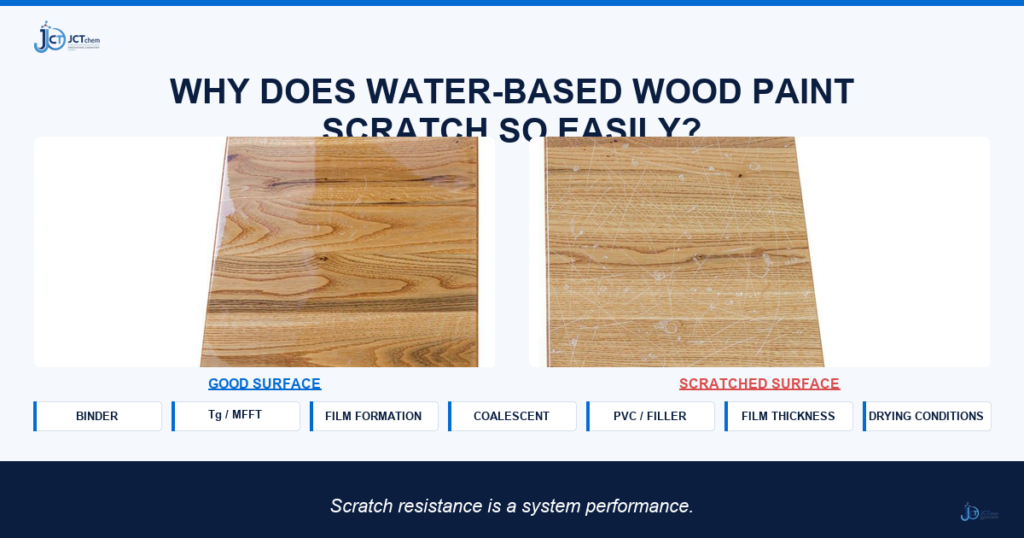
How to Improve Scratch Resistance in Water-Based Wood Coatings?
Scratch resistance is a system performance — not simply a resin property.
A water-based wood coating often looks good right after application: smooth, uniform, well leveled. Then the first scratches appear — during stacking, packaging, assembly or everyday use. When that happens, the binder usually gets the blame first. In practice, the answer is almost never a single raw material.
This guide walks through what a formulator should check, in order: binder selection, Tg and MFFT, film formation, coalescent balance, PVC and filler loading, film thickness, drying conditions — and the hardness–flexibility balance that ties them together.
Polymer type, hardness and film properties set the starting point — application-driven, not hardness-maximized.
Dry-to-touch is not the same as fully coalesced. Surface durability develops with the film.
Coalescent level, PVC and filler loading, and film thickness all shape the final surface.
Substrate, coats, wet/dry film thickness and drying conditions belong in every evaluation record.
01Why Scratch Resistance Is More Than Binder Hardness
The coating looks good after application — but scratches too easily during handling or use. What should the formulator check first?
This is one of the most common complaints with water-based wood coatings. The film is applied cleanly, levels well and has good visual quality. But under stacking, packaging, assembly or everyday contact, the surface picks up scratches, scuff marks and visible surface damage more readily than expected.
When that happens, the instinct is often to look for a “harder resin”. But the binder is only one contributor. The final scratch resistance of a water-based wood coating depends on how several variables interact:
- Binder selection — polymer type, hardness and toughness
- Tg and MFFT of the dispersion
- Completeness of film formation under real conditions
- Coalescent balance in the formulation
- PVC and filler loading
- Wet and dry film thickness
- Drying conditions — temperature, humidity, air movement
- The hardness–flexibility balance of the finished film
Each of these can limit the surface durability of the applied film. A formulation with a well-selected polymer can still scratch easily if film formation is incomplete; a hard, well-coalesced film can still disappoint if the coating is too brittle for the substrate or the end use.
02Start with the Right Binder
The binder is the largest single contributor to film properties, so it is the natural first check. In water-based wood coatings, the polymer platforms most often considered are acrylic emulsions, polyurethane dispersions (PUD) and polyurethane-acrylic hybrids — each with a different property profile.
Binder selection influences:
- Hardness of the polymer phase itself
- Flexibility over a moving, natural substrate
- Film cohesion — how well the film resists being torn or gouged
- Adhesion to primers, sealers and wood
- Blocking resistance of stacked or packaged parts
- Overall surface durability of the finished film
A harder polymer can support higher surface hardness, better blocking resistance and better scratch behavior. But pushing polymer hardness too far in a wood coating can reduce flexibility, increase brittleness and raise cracking risk over wood that moves with moisture.
Conversely, a softer, more flexible system can accommodate substrate movement and impact — but may not deliver the surface hardness that high-use furniture or flooring applications require.
For a wider view of the technology platforms, see the JCT acrylic emulsion resins range and the polyurethane dispersions portfolio.
03Check Tg and MFFT
Two polymer parameters are particularly useful when evaluating candidate dispersions for scratch-sensitive applications: the glass transition temperature (Tg) and the minimum film formation temperature (MFFT).
They describe different things:
- Tg describes the hardness character of the polymer phase — higher Tg polymers generally contribute harder, more scratch-resistant surface characteristics; lower Tg systems generally provide greater flexibility.
- MFFT describes the conditions the dispersion needs to form a continuous film — it determines how demanding the film formation window is at the application site.
Higher Tg can support a harder surface — but it typically comes with a higher MFFT, a narrower application window and reduced flexibility. Lower Tg systems coalesce more easily and flex more — but they may not deliver the surface hardness a high-use application requires.
Neither parameter works in isolation:
Grade-level suitability should always be confirmed against the supplier’s technical data and the actual conditions in the coating line, not from a single datasheet number.
04Make Sure Film Formation Is Complete
In a water-based coating, film formation is the process in which discrete polymer particles suspended in water fuse into a continuous film. If that process is incomplete, the film never reaches the mechanical properties the polymer was selected for — regardless of how well the resin was chosen.
Film formation is influenced by:
- Application and substrate temperature relative to MFFT
- Relative humidity and air movement over the wet film
- Coalescence behavior of the polymer under those conditions
- Film thickness — thicker films release water more slowly
- Polymer compatibility where multiple dispersions or modifiers are used
An important practical point: a surface that is dry to the touch is not necessarily a fully developed film. Surface dry happens first; the deeper coalescence and property development continue afterwards.
Incomplete film formation can contribute to:
- A softer surface than the polymer selection suggests
- Weak film cohesion — damage penetrates instead of being resisted
- Poorer surface durability and lower scratch resistance
- Inconsistent results between panels, batches or production days
- Substrate temperature recorded, not only air temperature
- Drying environment mapped — temperature, humidity, air movement
- Time allowed between coats and before testing documented
- Comparisons made at equal film thickness, not equal wet application
Not every scratch problem is a film-formation problem — but it is one of the most frequently overlooked contributors, because the surface already “looks fine” when the coating is handled.
05Review Coalescent Balance
Coalescents are added to help polymer particles soften and fuse under given drying conditions. Getting the coalescent balance right is directly connected to surface performance.
- Too little coalescence support — particles cannot fuse properly under the actual conditions; the film stays weak and may scratch readily.
- Too much, or the wrong type — the film can stay soft for longer, delaying hardness development and affecting early blocking resistance and surface feel.
Coalescent demand differs by polymer: a hard, high-Tg dispersion needs more coalescence support than a soft one, and a coalescent suited to one system may be poorly matched to another.
For this reason, specific coalescent recommendations belong to the formulation development work done with the raw-material supplier — not to a generic dosage rule.
06Consider PVC and Filler Loading
Pigment volume concentration — the ratio of pigment and filler volume to total dry film volume — has a strong influence on surface durability in wood coatings, especially in pigmented primers and tinted systems.
Used appropriately, fillers contribute to:
- Cost control in primers and undercoats
- Rheology and sanding behavior
- Opacity and build
- Surface characteristics such as matting
But as filler loading increases relative to binder, the continuous polymer phase has more solid surface to wet and bind. Excessively high filler loading can contribute to:
- Lower binder continuity through the film
- Weaker film cohesion — the film gouges and powders more easily
- Poorer surface durability and scratch resistance
When troubleshooting scratch complaints in pigmented layers, reviewing the PVC and filler package alongside the binder is usually more productive than changing the binder alone.
07Film Thickness Matters
Wet film thickness and dry film thickness both influence how the coating reaches its final properties:
- Water release — thicker films lose water more slowly, extending the film formation timeline
- Film formation — a deep film coalesces later than the surface skins
- Drying time — time between coats and before handling or testing scales with build
- Final film properties — hardness, scratch and blocking resistance develop as the full film develops, not only at the surface
A common pattern with overly thick coats:
For the formulator and the line, four numbers belong in every evaluation record:
- Wet film thickness per coat
- Expected dry film thickness per coat and total
- Number of coats in the full system
- Drying time and conditions between coats and before testing
Comparing formulations applied at different build produces misleading conclusions about scratch resistance — the thicker system may simply be behind on its property development.
08Hardness Is Not the Only Goal
The goal is not simply to maximize hardness, but to achieve the right balance of hardness, toughness, flexibility, adhesion and surface durability.
This is the central engineering point of the scratch-resistance question. Hardness, flexibility and toughness are related but not identical — and in wood coatings they trade off against each other:
| Property | Too Soft | Balanced | Too Hard |
|---|---|---|---|
| Flexibility | Higher | Balanced | Lower |
| Scratch Resistance | May be limited | Application-dependent | Potentially higher |
| Blocking Resistance | May be limited | Better balanced | Potentially better |
| Crack Resistance | Potentially better | Balanced | May decrease |
| Film Feel | Soft / tacky | Application-dependent | Hard / rigid |
Directional trade-offs only — the actual balance point depends on the coating type, substrate and end use.
A film that is too soft will mar and scratch readily under handling. A film that is too hard can scratch through brittleness — a hard but brittle film can be gouged or cracked by sharp contact, and it may crack over wood that swells and shrinks with moisture.
09Substrate and Application Conditions Also Matter
Wood is not a uniform, inert substrate. The same coating system can produce different scratch results depending on:
- Wood species and density — harder or softer woods support the film differently
- Substrate porosity — a porous surface can draw material away from the interface
- Sanding and surface preparation — roughness affects film uniformity and adhesion
- Primer choice — the total system, not just the topcoat, carries surface durability
- Application method — spray, curtain, roller and hand application lay the film down differently
- Number of coats — multi-layer systems build properties step by step
- Drying environment — temperature, humidity and airflow vary between lab and line
A practical consequence: laboratory drawdowns on sealed panels will not always predict results on real furniture parts sprayed in a production environment. The wood substrate, the line layout, the flash-off times and the drying room conditions all shift the outcome.
10Practical Troubleshooting Checklist
The table below maps commonly observed symptoms to where a formulator should start looking. It is a starting point for diagnosis — not a substitute for testing.
| Problem | Possible Causes | What to Check |
|---|---|---|
| Surface scratches easily | Film too soft | Binder selection, Tg, film formation |
| Good initial hardness but poor durability | Film too brittle | Hardness/flexibility balance |
| Different results between batches | Drying variation | Temperature, humidity, film thickness |
| Soft surface after drying | Incomplete film formation | MFFT, coalescent, drying conditions |
| Poor durability with high filler loading | Low binder continuity | PVC/filler balance |
Symptom patterns indicate where to start looking — confirmation requires testing on the actual system.
Work the table from the top down: soft-film symptoms first, then balance and brittleness, then variation and process effects, then formulation structure.
11How to Improve Scratch Resistance
When the decision is made to improve the scratch resistance of a water-based wood coating, a fixed investigation sequence keeps the work efficient. The sequence below mirrors the structure of this guide:
Step 1 — Define the Application
Furniture, interior joinery, flooring or high-use surfaces each define a different target balance. Write down the expected handling, contact and use conditions before touching the formulation — they determine what “good” means.
Step 2 — Review Binder Selection
Check polymer type, Tg, MFFT, and the hardness/flexibility profile of candidate dispersions against the application definition from Step 1. Confirm that the binder class (acrylic, PUD, hybrid) matches the surface performance the application requires.
Step 3 — Evaluate Film Formation
Review application temperature, substrate temperature, humidity and drying time against the MFFT of the selected dispersion. Verify that full property development is actually reached before surfaces are handled, stacked or tested.
Step 4 — Review Formulation Balance
Check filler level and PVC, coalescent type and level, and the additive package. Look for interactions — a coalescent level that suits one binder may under- or over-plasticize another; a filler package that suits one solids level may starve binder continuity at another.
Step 5 — Control Application Conditions
Standardize and record wet film thickness, dry film thickness, number of coats and drying intervals. Make sure comparisons between formulations are made at equal build and equal drying history.
Step 6 — Test the Complete System
Do not judge the binder alone. Test the finished coating system — primer and topcoat together, on the real substrate, at the real build — against the application requirements defined in Step 1.
12Recommended Testing
Scratch complaints should be settled with structured testing on the finished system, not with fingertip impressions. Depending on the application, the relevant tests include:
| Evaluation | What It Shows |
|---|---|
| Scratch resistance | How the surface responds to defined scratching contact |
| Pencil hardness | Comparative surface hardness of the film |
| Blocking resistance | How stacked or packaged surfaces resist sticking and printing |
| Abrasion resistance | How the surface withstands rubbing and wear over time |
| Adhesion | Whether the film remains bonded to the substrate and primer |
| Water resistance | How the film behaves after water exposure |
| Impact resistance | How the film responds to sudden mechanical stress |
Test methods should be selected based on the final application, customer requirements and in-house standards.
Two disciplines make results meaningful: test at a defined, recorded film thickness with a defined drying history — and test the complete system, not the binder in isolation. Scratch resistance measured on a freshly drawn-down lab panel is not the same property measured on a fully dried, production-applied coating.
13JCT Chemical for Water-Based Wood Coatings
Most scratch-resistance problems are not solved by a single raw material — but the right materials make the solution reachable. JCT Chemical supports water-based wood coating development across three technology platforms:
Waterborne acrylic dispersions for wood primers, sealers and topcoats, spanning different hardness, flexibility and film-formation requirements — from easy-coalescing, flexible grades to hard, fast-blocking systems. See the acrylic resins range.
Polyurethane dispersions and PUA hybrids for coating systems where enhanced surface and mechanical performance may be required — including high-hardness and fast hardness development options. See the polyurethane dispersions range.
Additives supporting wetting, dispersing, defoaming, rheology control and formulation stability — selected for compatibility with water-based wood coating systems. See the functional additives range.
The grades below are selected from the JCT wood coating portfolio — presented as options for formulation evaluation, not as a ranking.
14Related JCT Products
JCT-651
Cationic acrylic dispersion with very high hardness and good water resistance; excellent anti-swelling performance on solid-wood substrates; thick films without bubbling.
Typical product characteristics — refer to the official TDS for current specifications.
JCT-16U
Polyurethane-acrylic hybrid (PUA) with high hardness and fast hardness development; excellent early blocking resistance and sanding properties; good transparency.
Typical product characteristics — refer to the official TDS for current specifications.
JCT-105U
Polyurethane dispersion with excellent water resistance and very high transparency; good warm-wood effect and high build; can be combined with isocyanate crosslinkers for highly water-resistant matt coatings.
Typical product characteristics — refer to the official TDS for current specifications.
JCT-655
Waterborne acrylic emulsion for wood primers and topcoats — low-odor, high-solids, high build, with excellent early blocking resistance, good water resistance and a low film-forming temperature.
Typical product characteristics — refer to the official TDS for current specifications.
Explore the full wood coating portfolio on the Water-Based Wood Coatings application page →
Key Takeaways
“The best wood coating is not necessarily the hardest coating. It is the coating that achieves the right balance of hardness, toughness, flexibility and durability for its intended application.”
Related Guides
15FAQ
How can I improve scratch resistance in water-based wood coatings?
Work through the system rather than the binder alone: confirm the polymer matches the application, verify film formation is complete under real drying conditions, review the coalescent balance, check PVC and filler loading, control film thickness, and test the complete coating system on the actual substrate. Scratch resistance is a system performance — the improvement usually comes from bringing several variables into balance.
Does a higher Tg always mean better scratch resistance?
No. Higher Tg supports harder surface characteristics, but it also tends to reduce flexibility, raise MFFT and narrow the film formation window. A hard but brittle film can still be damaged by sharp contact, and it may crack over wood that moves with moisture. Tg is one selection input — it should be considered together with MFFT, formulation and drying conditions.
Can a harder binder make a wood coating more brittle?
It can. Pushing polymer hardness toward the extreme generally trades flexibility and crack resistance for surface hardness. Wood is a dimensionally active substrate, so a film that is too rigid can crack when the wood swells or shrinks. The goal is the right balance of hardness, toughness and flexibility for the end use — not the maximum of any one property.
How does film thickness affect scratch resistance?
Thicker films dry and coalesce more slowly: the surface may feel dry while water release and film formation continue inside. Hardness and scratch resistance develop with the complete film, so an overly thick coat can show weaker surface performance simply because property development is behind. Recording wet film thickness, dry film thickness, number of coats and drying time makes results comparable.
Can high filler loading reduce surface durability?
It can. As filler volume increases relative to binder, polymer continuity through the film decreases, which can weaken film cohesion and lower resistance to gouging and marring. Fillers still play valuable roles in cost, rheology, opacity and sanding — the point is to keep the binder-to-filler balance appropriate for the layer and the application, not to minimize filler at all costs.
Why does the same coating perform differently under different drying conditions?
Drying conditions control whether and how quickly film formation is completed. Low temperature, high humidity or still air slow water release and coalescence, so the same formulation can produce a softer, less scratch-resistant surface on a cool, damp day than on a warm, dry one. Substrate temperature matters too — a cold panel delays film formation even when the air feels acceptable. This is why drying conditions belong in every evaluation record.
Need help selecting materials for your water-based wood coating?
JCT Chemical supplies acrylic emulsions, polyurethane dispersions and functional additives for water-based coating systems. Tell us your substrate, application method and performance requirements — our technical team can recommend suitable grades and provide technical information and samples for evaluation.